
Bullying rarely begins with cruelty.
It begins with permission.
Not spoken permission.
Not written permission.
The quiet permission that forms when dignity is not defended.
Most people imagine bullying as the loud voice in the room, the one who insults, threatens, humiliates, or dominates. That image is easy to recognize because it is obvious. What is far harder to see is the invisible environment that allows that voice to continue. Bullying survives not simply because someone chooses cruelty, but because a surrounding culture slowly decides that interrupting it feels too costly.
In homes, schools, and workplaces, people constantly read the emotional temperature of the room. Human beings are wired for belonging. Our nervous systems are always asking a silent question: Is it safe for me to remain here? When someone becomes the target of ridicule or intimidation, everyone watching performs a calculation that happens faster than conscious thought. If I defend them, I might become the next target. If I stay silent, I remain protected.
Most people choose safety.
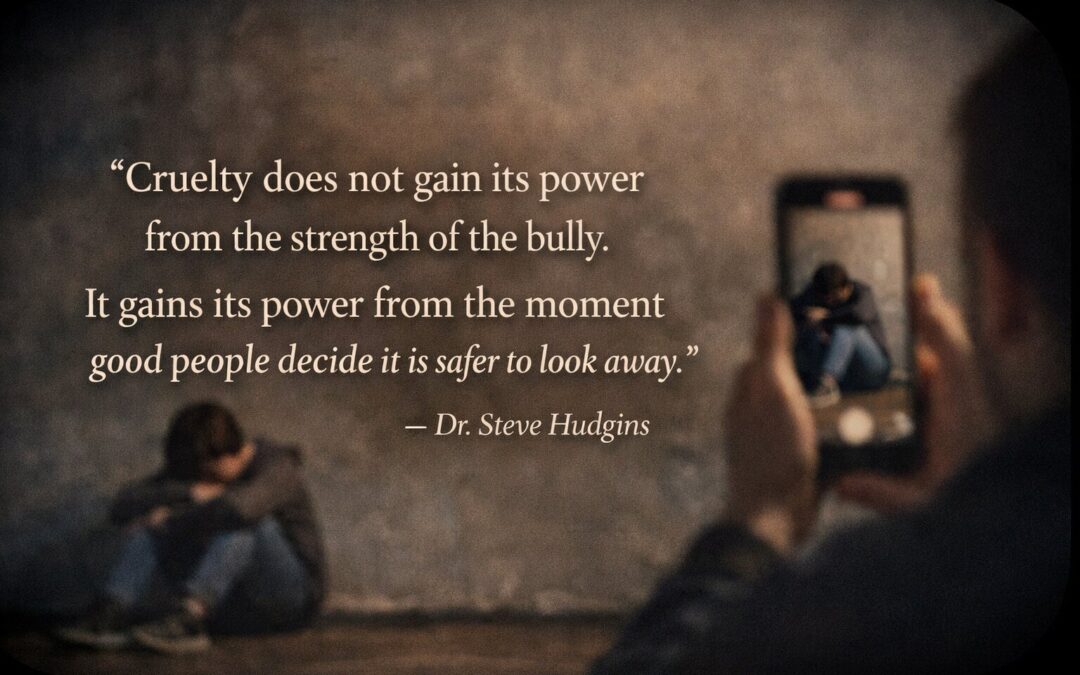
Not because they are cruel, but because they are afraid, and this is where bullying quietly gains its strength.
The aggressor may initiate the harm, but the silence around the moment becomes the structure that allows it to continue. Over time, the room learns something dangerous. People learn which voices are protected and which are not. They learn what the group rewards and what it punishes. Slowly, the culture shifts. What once felt uncomfortable becomes familiar. Familiarity slowly becomes acceptance.
Cruelty begins to feel normal.
In our time, another layer has been added to this dynamic. The bystander no longer watches. The bystander can now broadcast. When someone records a moment of humiliation instead of interrupting it, something profound changes. The harm is no longer confined to a single moment. A person’s most vulnerable experience becomes permanent content. The individual holding the camera may believe they are documenting something. In reality, they are extending the humiliation beyond the moment, multiplying the audience, and giving the aggressor the one thing every bully unconsciously seeks.
Attention.
Without attention, bullying weakens.
Without an audience, intimidation loses much of its power, but when pain becomes spectacle, cruelty receives applause.
The most unsettling truth about bullying is that it rarely requires many people to sustain it. It only requires enough people who decide that protecting themselves matters more than protecting another person’s dignity. Silence becomes a social contract. No one writes the agreement, yet everyone understands it.
Until someone breaks it.
When one person interrupts cruelty, something remarkable happens. The illusion of the bully’s power fractures. Others who felt the same discomfort suddenly realize they are not alone. Courage spreads through a room in the same way fear once did. The culture begins to change in real time.
The most powerful environments are not those where bullying never occurs.
They are the ones who defend dignity the moment it is threatened.
The deeper question is not simply who the bully is. The deeper question is, what will the room become when the moment arrives?
Because every environment eventually faces the same test.
Will dignity be protected, or will silence be chosen?
And the answer to that question shapes far more than one moment. It shapes the culture people must live in every day.