
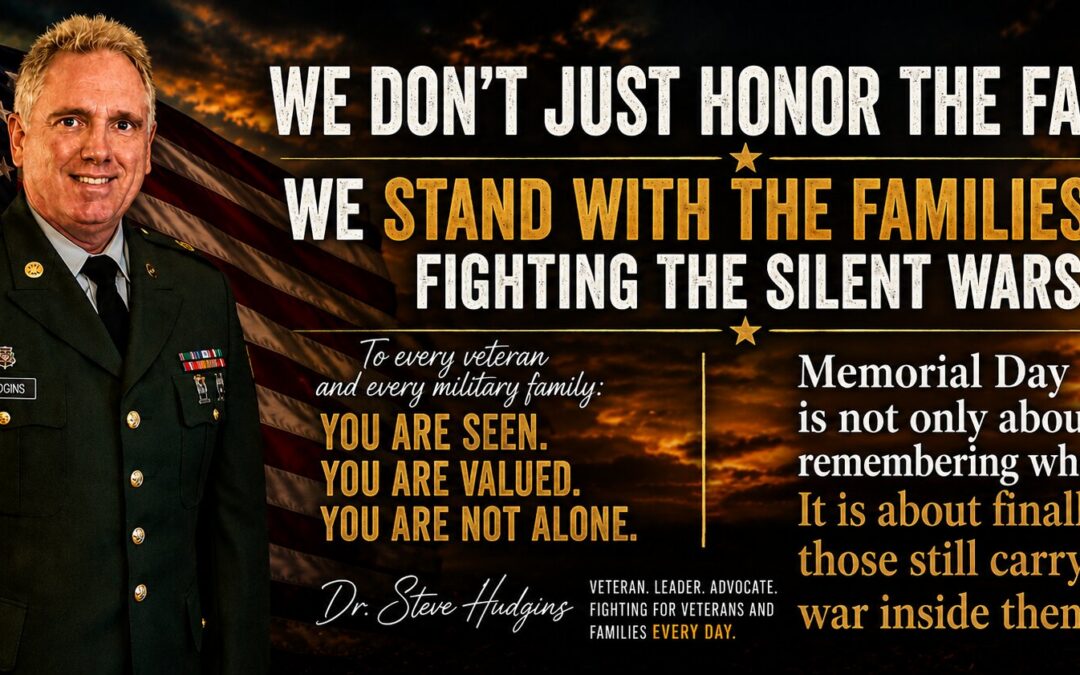
Most people think Memorial Day is about remembering the dead.
What we rarely discuss is how many families are still trying to survive the living aftermath of war long after the uniform comes off.
- The flag folds neatly.
- The ceremony lasts an hour.
- The salute echoes.
- People post photos with captions about freedom and sacrifice.
Then Monday ends, and thousands of families quietly return to battles nobody sees.
That is the part we do not talk about enough.
As a veteran, I understand something many people never fully see.
War rarely stays on foreign soil.
Sometimes it follows people home quietly.
It sits at dinner tables.
It sleeps beside marriages.
It echoes through nervous systems.
It shapes children who learned to read emotional tension before they learned algebra.
It changes families.
We honor the soldier who died overseas, but often overlook the marriage slowly crushed beneath the weight of trauma back home. We recognize the battlefield injury while missing the emotional shrapnel that followed veterans into the living room, the bedroom, the nervous system, and the emotional atmosphere of an entire family.
For military families, especially mosaic families trying to rebuild life after divorce, remarriage, separation, trauma, deployments, or emotional fragmentation, Memorial Day carries layers of grief most people never discuss.
Some families are not only carrying military sacrifice.
They are carrying relational sacrifice too.
The veteran who came home emotionally different.
The spouse who learned to survive emotional distance.
The child caught between two homes while also trying to understand a parent shaped by hypervigilance, silence, insomnia, anger, emotional shutdown, or pain they cannot explain.
That is the part we do not put on patriotic T-shirts.
Many veterans do not know how to explain what changed inside them because trauma is not always stored in words. Often it is stored in reactions. Withdrawal. Irritability. Isolation. Emotional numbness. The inability to fully feel present even when surrounded by people they deeply love.
Families feel it.
Children begin learning the emotional weather patterns of the home. Spouses start walking carefully around moods they do not fully understand. Conversations become shorter. Emotional distance slowly becomes normalized. Everyone adapts. Everyone survives.
Yet survival is not the same thing as connection.
What fascinates me clinically is how military families often become experts at endurance while quietly starving for emotional safety.
- The veteran may feel guilty for what they cannot explain.
- The spouse may feel guilty for feeling exhausted.
- The children may internalize confusion they do not yet have language for.
Nobody wants to dishonor the sacrifice, so many families suffer silently inside it.
That silence becomes its own kind of battlefield.
Mosaic families feel this deeply because rebuilding a family after brokenness already requires enormous emotional labor. Add unresolved trauma, co-parenting stress, emotional shutdown, identity struggles, or survival-based coping patterns, and suddenly home itself can begin feeling emotionally fragmented.
Not because people do not love each other, but because pain changes the nervous system.
Perhaps one of the most painful realities is this: many veterans were trained how to survive war, but very few were taught how to return to peace.
The body remembers danger long after the environment changes. Trauma teaches people to stay prepared, guarded, alert. Love, however, requires something entirely different. Love requires safety. Presence. Softness. Trust. Vulnerability.
Those are difficult transitions for a nervous system conditioned for survival.
This is why some veterans sit in crowded family rooms feeling emotionally alone.
Not because they do not love deeply, but because part of them never fully left the battlefield.
As a veteran, I honor the men and women who served and I also honor the wives who held families together while feeling emotionally alone.
The husbands who learned to love through exhaustion.
The children who adapted too quickly.
The stepparents trying to create belonging inside homes already carrying grief.
The mosaic families trying to build unity from shattered pieces.
Military families serve too.
They absorb absence, unpredictability, fear, relocation, emotional fragmentation, grief, and the invisible weight of survival in ways that rarely receive public acknowledgment.
This Memorial Day, remember the fallen.
Honor the living.
Protect the struggling.
See the invisible battles.
Some military families are still fighting wars nobody around them realizes exist.
Maybe the most patriotic thing we can do is not simply wave flags or repost quotes about freedom.
It is creating environments where veterans and families no longer feel they must carry invisible pain alone.
Because some people came home from war physically.
However, emotionally, part of them is still waiting for someone to help them feel safe enough to return.
Be safe. Honor the dead by a moment of silence. Be supportive of those who lost a family member. The military is a military family in a family!