
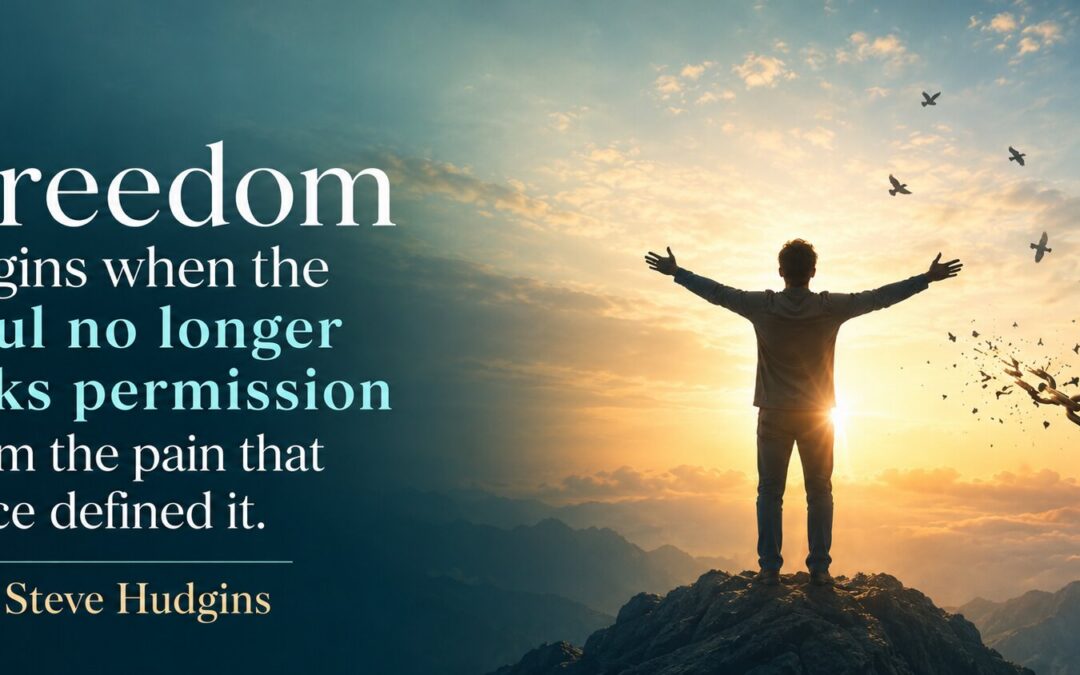
Why physical liberty is incomplete without emotional freedom.
We often speak of freedom as though it is something granted by governments, defended by soldiers, or secured by the absence of visible chains. We raise flags, honor sacrifice, and remember the price paid by those who protected our right to live, speak, worship, gather, and choose.
That freedom matters. It should never be diminished.
Yet there is another form of captivity that does not appear on a battlefield, inside a prison, or beneath the rule of an oppressive government. It exists quietly within the human heart.
- A person can live in a free country and still be governed by fear.
- A person can leave an abusive relationship and remain emotionally controlled by the abuser’s voice.
- A person can survive childhood and still organize adult life around the wounds created there.
- A person can have every legal right to speak and still be terrified of telling the truth.
Some chains are not wrapped around the body. They are woven into the beliefs we carry about ourselves.
During conversations on the Coached Soul podcast, I am often reminded that the most important human stories do not begin with what happened.
They begin with what the person was forced to become as a result of what happened.
Behind the composed face may be a child who learned never to need anything.
Behind the anger may be a man who was never taught how to grieve.
Behind the constant caretaking may be a woman who learned that love had to be earned through exhaustion.
Behind the humor may be someone who discovered early that laughter could keep others from asking painful questions.
These adaptations may have helped us survive.
In contrast, survival and freedom are not the same thing.
When the Past Becomes an Invisible Government
Emotional captivity rarely announces itself. It usually appears as normal behavior.
We call it being responsible when we are actually afraid to disappoint anyone.
We call it loyalty when we are unable to establish boundaries.
We call it strength when we refuse to admit that we are hurting.
We call it forgiveness when we have merely learned to remain silent.
We call it peace when everyone has agreed not to speak about what happened.
The human nervous system remembers what the conscious mind would prefer to forget. It learns which emotions are dangerous, which subjects must be avoided, and which version of the self is most likely to preserve connection.
Over time, the wound becomes more than a memory.
It becomes an internal authority.
It tells us whom to trust, how much love we deserve, when to remain quiet, and what we must do to prevent abandonment. Long after the original danger has passed, we may continue obeying rules written during a season of fear.
The past does not have to remain present to remain powerful. It only needs our continued obedience.
This is why emotional freedom requires more than leaving a painful place. It requires examining the internal laws that painful place left behind.
The relationship may be over, yet its accusations continue.
The childhood home may be gone, yet its roles remain.
The critical parent may no longer be present, yet the child still hears the criticism from inside.
The war may have ended, yet the body continues to stand guard.
Physical distance can remove us from a source of pain. Emotional freedom begins when that source no longer determines who we are allowed to become.
Freedom Is Not the Absence of Emotion
Many people mistake emotional freedom for emotional detachment. They believe healing means no longer feeling anger, grief, fear, or disappointment.
Freedom is not the absence of difficult emotions. It is the ability to experience those emotions without surrendering leadership of our lives to them.
Fear may speak, but it does not have to make the decision.
Anger may arrive, but it does not have to destroy the relationship.
Grief may remain, but it does not have to become our identity.
The goal is not to silence every painful feeling. The goal is to understand what the feeling is protecting, what story it is carrying, and whether that story still belongs in the present.
Clinically, many of our strongest reactions are not simply responses to what is happening now. They are responses to what the present moment resembles.
A delayed text begins to feel like abandonment.
A disagreement begins to feel like rejection.
A spouse’s frustration begins to sound like a parent’s contempt.
A boundary begins to feel like betrayal.
The adult may be standing in the present, while the nervous system is fighting something from years ago.
A trigger is often the past borrowing the face of the present.
Emotional maturity begins when we can pause long enough to ask, “What is actually happening, and what older wound has entered the room with me?”
That question does not excuse harmful behavior. It exposes its deeper architecture.
The Family System Often Resists Freedom
Individual healing never happens in isolation.
Every person belongs to relational systems that have developed expectations around who they are supposed to be.
The responsible one is expected to keep carrying everyone.
The peacemaker is expected to absorb conflict.
The strong one is expected not to need support.
The scapegoat is expected to remain the problem.
The quiet one is expected not to tell the family’s secrets.
When a person begins to heal, the system may interpret growth as rebellion. Boundaries may be called selfishness. Honesty may be called disrespect. Independence may be called abandonment. The person who stops participating in dysfunction may suddenly be accused of creating it.
This is one of the most painful truths about emotional freedom: sometimes people benefited from the version of us who was not free.
Not everyone will celebrate your healing, especially when your wounds once made you easier to control.
This does not mean we must become cold, hostile, or disconnected. Genuine freedom is not vengeance. It is the recovery of choice.
It is the ability to love without disappearing.
To forgive without surrendering discernment.
To remain compassionate without becoming responsible for another person’s consequences.
To honor family without allowing family history to dictate the future.
Healthy boundaries are not walls built to punish others. They are doors through which relationships must learn to enter respectfully.
The Courage to Become Emotionally Honest
There is a moment in healing when a person realizes, “I am no longer only recovering from what others did to me. I am confronting what I learned to do to myself.”
We silence ourselves before anyone else can reject us.
We minimize our needs before anyone can call us difficult.
We abandon our dreams before anyone can say we will fail.
We remain in unhealthy places because familiar pain feels safer than unfamiliar possibility.
This realization can be painful because it removes the illusion that freedom depends entirely upon someone else changing. But it is also the place where personal authority begins to return.
Emotional freedom begins when we stop asking the people who wounded us for permission to heal.
We may never receive the apology.
The family may never acknowledge the damage.
The former partner may never understand.
The person who harmed us may continue telling the story in a way that protects their own innocence.
Freedom cannot remain dependent upon their confession.
This does not mean justice is unimportant. It means our healing cannot be held hostage by another person’s refusal to tell the truth.
There comes a time when we must decide whether the wound will remain the author of our identity or become one chapter in a much larger story.
The Spiritual Meaning of Freedom
Spiritual freedom is sometimes reduced to the idea that faith should remove pain. Yet faith does not always remove the wilderness. Sometimes it teaches us who we are while walking through it.
God does not merely call people out of captivity. He must also teach captives to come out of them.
Israel left Egypt in a single night, but the mentality of slavery followed them into the wilderness. Their bodies had been released before their inner world had learned how to live freely.
That remains one of the deepest spiritual pictures of human healing.
We may leave Egypt while still fearing Pharaoh.
We may cross the sea while still questioning whether freedom is safe.
We may pray for a new life while continuing to think with the mind of the old one.
Deliverance can happen in a moment. Learning to live delivered may take a lifetime.
Grace does not deny our wounds. It refuses to allow those wounds to become the final definition of who we are.
Faith invites us into a deeper identity, one that is not built solely from what happened to us, what others called us, or what we once had to become in order to survive.
A Different Declaration of Independence
Perhaps we need a personal declaration of independence.
Not one written against people, but against the internal powers that have ruled us for too long.
I will no longer confuse silence with peace.
I will no longer call self-abandonment love.
I will no longer measure my worth by how much pain I can tolerate.
I will no longer apologize for having needs, limits, emotions, or a voice.
I will honor the part of me that survived, but I will not require survival mode to lead the rest of my life.
Freedom is not doing whatever we want without consequence. Emotional freedom is becoming conscious enough to choose our responses rather than repeatedly reenacting our wounds.
It is the ability to remain present when the past tries to pull us backward.
It is the courage to tell the truth without becoming cruel.
It is the maturity to love without possession, serve without self-erasure, and forgive without returning to captivity.
The deepest freedom is not merely escaping what held us. It is becoming someone who no longer needs the old chains to feel safe.
We should continue honoring those who defended our physical freedom. Their sacrifice gave us space to live our lives openly and courageously.
Perhaps the most meaningful way to honor freedom is to stop allowing inherited fear, unresolved trauma, relational control, and unspoken shame to govern the life that sacrifice made possible.
A nation may declare its independence in a single document. A human soul often declares its independence one honest decision at a time.
Freedom begins outside us when the chains are removed. It becomes complete within us when we finally stop carrying them.